
Propagation
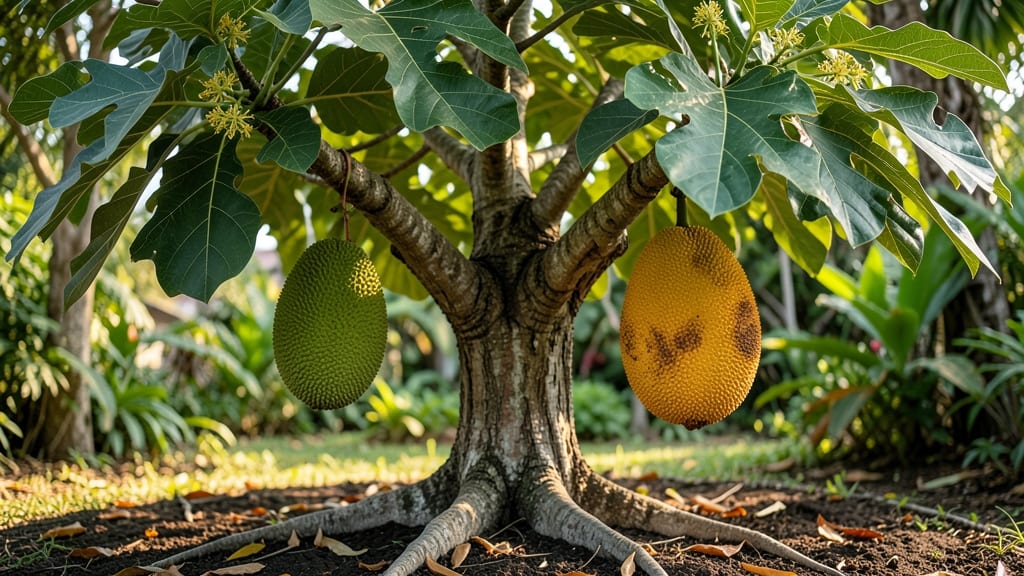
Jackfruit comes from the tropical rainforests of South and Southeast Asia, where it grows wild in regions like India, Sri Lanka, and the Western Ghats. This hardy fruit thrives in warm, humid climates and is now cultivated commercially in Thailand, Indonesia, and Brazil.
This giant fruit's journey began in the lush forests of South Asia, where ancient trees still produce wild varieties. 🌿 The Western Ghats region, with its monsoon-driven climate, created the perfect conditions for jackfruit to flourish naturally.
Today, you'll find thriving commercial plantations across Southeast Asia and even in unexpected places like Florida and Hawaii, where gardeners recreate tropical conditions through careful irrigation and soil management.
The fruit's adaptability stems from its deep roots in humid environments—it needs consistent moisture and temperatures above 60°F to produce its signature sweet, fibrous flesh. While it now grows globally, its heart remains in those original rainforest ecosystems where it evolved over centuries.
💡 In This Article
- Jackfruit’s Native Habitat and Climate Requirements
- Global Jackfruit Cultivation Hotspots and Growing Conditions
Jackfruit’s native habitat and climate requirements
The jackfruit tree, scientifically known as Artocarpus heterophyllus, traces its roots to the ancient tropical rainforests of the Western Ghats in India and Sri Lanka. This UNESCO World Heritage site provides the ideal microclimate: year-round humidity, abundant rainfall (typically 100-200 inches annually), and temperatures consistently above 75°F.
The region's monsoon-driven seasons create perfect conditions for the tree's rapid growth, with mature specimens reaching heights of 60-80 feet and producing fruits weighing up to 80 pounds. 🌿
The tree's success in these environments stems from its deep root system that accesses moisture from deep underground, combined with broad leaves that minimize water loss through transpiration.
Jackfruit trees require well-draining, slightly acidic soil (pH 5.5-6.5) rich in organic matter—a combination found naturally in the Western Ghats' volcanic soil deposits.
What's fascinating is how the tree's flowering mechanism is triggered by specific humidity levels and temperature fluctuations, typically between 77-86°F, which explains why it struggles in cooler climates where these conditions aren't met.
Rainfall patterns are equally critical to jackfruit development. The fruit itself forms during the monsoon season when consistent moisture ensures proper cell division in the developing fruit's fibrous matrix.
In its native habitat, jackfruit trees produce 1-2 main crops annually, with the primary harvest occurring during the wet season when fruits reach their peak sweetness.
This seasonal pattern explains why jackfruit is often called a "monsoon fruit"—its flavor profile is directly tied to the region's natural water cycle. 🌧️
What makes jackfruit particularly vulnerable outside its native range is its sensitivity to temperature drops below 50°F. The tree's tropical origins mean its cellular structure lacks the cold tolerance found in temperate species. Even brief exposure to frost can damage the cambium layer, preventing new growth.
This is why jackfruit trees in non-native regions require year-round protection from cold snaps, often through strategic planting near heat-retaining structures or using frost cloths during winter months.
Interestingly, the Western Ghats' biodiversity plays a crucial role in jackfruit's natural pollination. The tree relies on both wind and specific insect pollinators that thrive only in these humid environments.
When transplanted to new regions, growers must often introduce these pollinators artificially, which explains why some commercial jackfruit orchards in Thailand or Florida require manual pollination to achieve optimal yields. This ecological dependency highlights why the fruit's native habitat remains its most productive growing zone.
The jackfruit's native range also explains its incredible genetic diversity. Wild varieties in the Western Ghats exhibit remarkable variation in fruit size, shape, and flavor—some with spiky green skins and others with smooth, yellow-hued exteriors.
This biodiversity has allowed the fruit to adapt to various microclimates within its native region, from coastal areas to higher elevations up to 5,000 feet, where temperatures are cooler but humidity remains high. 🌺