
Blooming
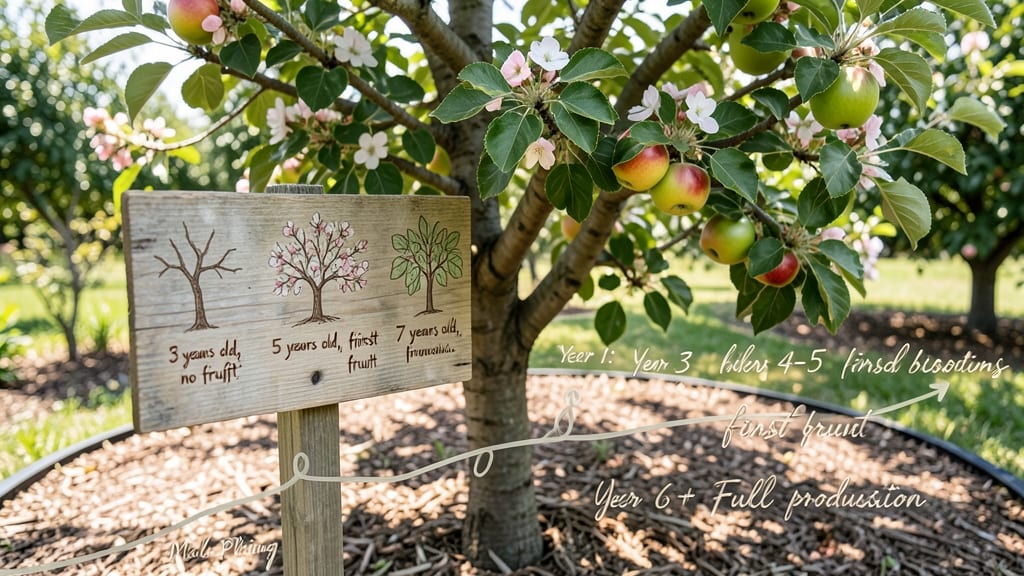
Apple trees usually take 3 to 7 years before they bear fruit, though this timeline shifts based on the specific variety, rootstock type, and your local climate—especially chill hours. Smaller dwarf varieties often produce fruit sooner, while larger standard trees may take longer. Giving your tree proper care and ensuring good pollination can help speed up the process.
This waiting period isn't just about time—it's about your tree reaching maturity and developing the right conditions to fruit. 🍎 Most apple varieties need 500 to 1,000 chill hours (temperatures between 32°F and 45°F) each winter to trigger blooming.
If your area doesn't meet these requirements, you might need to choose cold-hardy varieties like 'Honeycrisp' or 'Liberty' instead of tropical ones. Even with ideal conditions, proper pruning and balanced fertilization play a huge role in encouraging early fruit production.
For those eager to enjoy homegrown apples sooner, selecting dwarf rootstocks like M.9 or B.9 can cut the wait to just 2-3 years. Pairing your tree with a compatible pollinator variety also makes a noticeable difference—many apple trees are self-pollinating, but cross-pollination often leads to better fruit sets.
I've found that avoiding over-pruning and maintaining healthy soil with adequate nitrogen, phosphorus, and potassium speeds up fruiting in my own orchard.
💡 In This Article
- How Chill Hours Determine Apple Tree Fruiting Time
- Fastest Ways to Get Fruit from Apple Trees Sooner
How chill hours determine apple tree fruiting time
Chill hours are the secret code for apple tree fruiting—these are the cumulative hours your tree spends in dormancy at temperatures between 32°F and 45°F each winter. Most commercial apple varieties need 500 to 1,000 chill hours annually to break dormancy and trigger blooming.
For example, 'Honeycrisp' thrives with 600-800 chill hours, while 'Fuji' requires 800-1,000 hours—a mismatch can leave your tree barren for years. 🌡️ Without enough chill, buds remain dormant, and even if your tree grows, it won’t flower or fruit.
The science behind this involves a plant hormone called abscisic acid, which accumulates during cold exposure and signals the tree to stop dormancy. Varieties like 'Granny Smith' (needing 500-700 chill hours) are better suited for warmer climates, while 'McIntosh' (requiring 800-1,000 hours) struggles in mild-winter regions.
To check your area’s chill hours, consult the USDA Plant Hardiness Zone Map or local agricultural extension services—they provide precise data that can save you from planting the wrong variety.
If your region falls short, low-chill varieties like 'Anna' (300-500 hours) or 'Dorsett Golden' (400-600 hours) are excellent choices. Alternatively, some growers use artificial chilling—storing potted trees in a cold room during winter—but this is labor-intensive and best left to commercial operations.
For home gardeners, selecting the right variety based on your local chill hours is the simplest way to ensure your tree fruits on schedule.
Temperature fluctuations also play a role—consistent cold (like in mountainous regions) is more effective than erratic cold snaps. For instance, a tree in Zone 6 (with 1,000+ chill hours) will fruit reliably, while one in Zone 8 (with 300-500 hours) may need a low-chill variety or supplemental chilling.
Even a single winter with insufficient chill can delay fruiting by 1-2 years—so accuracy matters!
Here’s how to verify your chill hours: Use a chill hour calculator (available from universities like Cornell or Oregon State) and plug in your winter lows. For example, if your winters average 40°F for 600 hours, you’re likely in the sweet spot for 'Honeycrisp' but not 'Fuji'.
This step alone can cut years off your wait time and prevent frustration.
One common misconception is that all apple trees need the same chill hours—nothing could be further from the truth. 'Liberty' apples, bred for disease resistance, require 800-1,000 hours, while 'Pink Lady' needs 600-800 hours.
Matching your tree to your climate isn’t just about speed; it’s about whether your tree will ever fruit at all. 🍏
Pro tip: If you’re in a borderline zone, consider planting a multi-grafted tree—a single tree with branches from different varieties (e.g., one low-chill and one standard-chill) to hedge your bets. This way, even if one graft struggles, the other may thrive.