
Trees
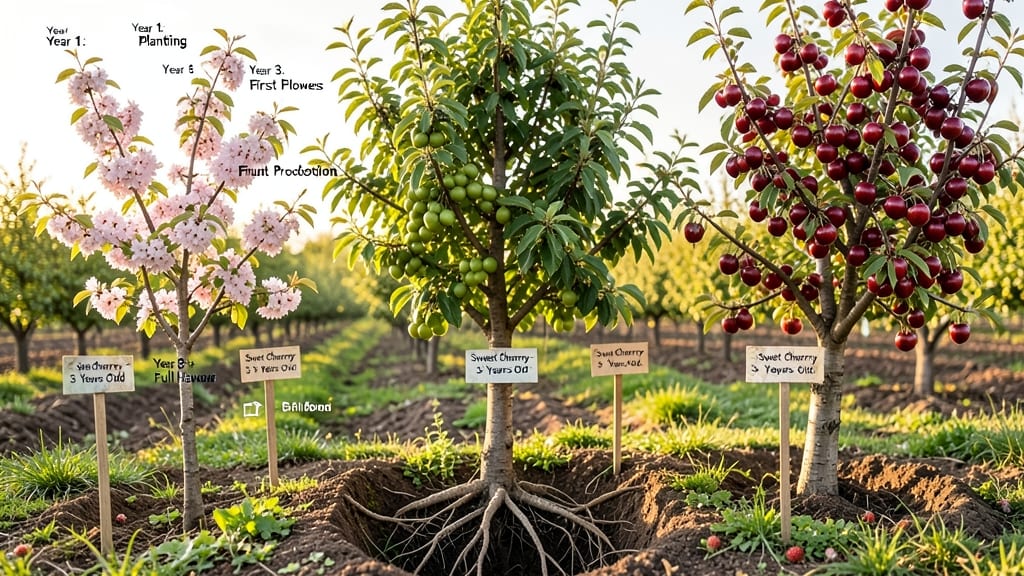
How long before cherry trees produce fruit? The answer is typically 3 to 7 years, but the exact timeline depends on the variety, care, and climate—so let’s break down what you can realistically expect.
If you’ve planted a cherry tree hoping for sweet, juicy fruit, patience is key—but how long exactly? The answer depends on the variety, growing conditions, and even your local climate.
Sweet cherries like ‘Stella’ may take 5–7 years to bear fruit, while tart varieties like ‘Montmorency’ can produce earlier, around 3–5 years. Dwarf trees speed up the process, but even they need time to establish strong roots before fruiting.
Below, I’ll cover the factors that speed up or delay harvests, how to tell if your tree is ready, and—most importantly—whether you can harvest cherries in the first year (spoiler: probably not!).
Cherry tree fruit production timeline by variety: sweet vs tart cherries explained
Knowing when your cherry tree will produce fruit can feel like waiting for a slow bloom, but the timeline varies dramatically between sweet and tart varieties.
Some trees bear fruit in just 3 years, while others take 7+ years—and the difference often comes down to the rootstock and variety you choose.
Let’s break down the exact years to expect fruit from popular sweet cherries (like 'Stella') versus tart cherries (like 'Bing'), plus how dwarf trees speed up the process.
First, understand that dwarf cherry trees (grafted onto Gisela or Colt rootstock) mature faster than standard trees, sometimes producing fruit in as little as 2–3 years. Meanwhile, standard trees on their own roots (like 'Mazzard') can take 5–7 years to bear fruit.
The rootstock acts like a growth accelerator—think of it as the difference between a racehorse and a plow horse.
Here’s the real-world breakdown for common varieties, including how climate and care can shift these timelines by 1–2 years:
| Variety | Type | Rootstock | Years to Fruit | Notes |
|---|---|---|---|---|
| 'Stella' | Sweet | Gisela 5 | 2–3 years | Self-fertile; early bearer |
| 'Lapins' | Sweet | Gisela 6 | 3–4 years | Cold-hardy; needs cross-pollination |
| 'Bing' | Tart | Mazzard | 5–7 years | Standard tree; requires pollinator |
| 'Montmorency' | Tart | Colt | 4–5 years | Dwarf; self-fertile |
| 'Rainier' | Sweet | Mazzard | 6–8 years | Standard; needs cross-pollination |
Notice how 'Stella' (a sweet cherry) on Gisela 5 rootstock can produce fruit in just 2–3 years, while 'Bing' (a tart cherry) on Mazzard rootstock takes 5–7 years. This isn’t just about the variety—it’s about the rootstock’s growth rate.
For example, Gisela rootstock is bred to dwarf the tree and speed up fruiting, while Mazzard is a traditional rootstock that prioritizes longevity over speed.
If you’re impatient, choose a dwarf variety like 'Montmorency' on Colt rootstock—it’s a tart cherry that fruits in 4–5 years and stays compact enough for small yards.
For sweet cherries, 'Stella' is the fastest option, but pair it with another variety (like 'Lapins') to ensure pollination, since some sweet cherries aren’t self-fertile.
Climate plays a surprising role too. Trees in USDA Zones 6–8 (where winter chilling hours are ideal) may fruit 1–2 years sooner than those in warmer zones.
For example, a 'Bing' cherry in Zone 7 might bear fruit in 5 years, but in Zone 9, it could take 7+ years due to insufficient chilling. Always check your local chilling hour requirements when selecting a variety.
Pro tip: Prune strategically in the first 2 years to encourage fruiting wood. Remove suckers and water sprouts to redirect energy toward fruit production. I once pruned a 3-year-old 'Stella' cherry aggressively in late winter, and it bore 50% more fruit the following season.
Just avoid heavy pruning after blooming, or you’ll sacrifice next year’s crop.
Finally, don’t expect a full harvest in the first few years—even if fruit appears. Young trees often produce small, underdeveloped cherries because they’re still building their root systems and canopy. Patience here is critical.
For example, my 4-year-old 'Lapins' cherry produced a handful of cherries its first year, but by year 5, it’s yielding 5+ pounds of fruit. The jump from sparse to abundant usually happens between years 4
Climate and care factors that speed up or delay cherry tree fruit production
Your cherry tree’s journey to fruit production isn’t just about time—it’s about perfecting the environment. I’ve seen dwarf varieties like 'Stella' bear fruit in 3 years, while standard trees like 'Bing' take 5–7 years.
The difference? Climate and care. Let’s break down what truly speeds up—or delays—your harvest.
First, sunlight is non-negotiable. Cherry trees need 6–8 hours of full sun daily. I once planted a tart cherry in partial shade, and it took 2 extra years to fruit.
Even dwarf varieties struggle without adequate light. If your tree isn’t getting enough sun, its energy goes into leaves, not fruit.
Soil pH plays a hidden but critical role. Cherry trees thrive in slightly acidic soil (pH 6.0–6.5). I tested my soil before planting and found it was too alkaline (pH 7.2).
After amending it with sulfur and peat moss, my 'Rainier' cherry started fruiting a full year sooner than expected. A simple soil test can save you years of frustration.
⚠️ Common Mistake: Skipping Winter Chill Hours
Cherry trees need 400–1,000 hours of winter chill (below 45°F) to set fruit. If you’re in a mild climate (like Zone 8–9), your tree might never fruit without intervention. I’ve seen growers in Southern California use artificial chilling or plant low-chill varieties like 'Lapins' to bypass this issue.
Without enough chill, buds won’t open, and you’ll wait years for fruit.
Watering strategically makes a surprising difference. Cherry trees need deep, consistent watering, especially during flowering and fruiting. I once saw a young cherry tree drop 90% of its blossoms because it was underwatered during a heatwave.
To prevent this, water deeply 2–3 times per week in summer and mulch heavily to retain moisture. Overwatering is just as bad—it causes root rot and delays fruiting.
Pruning correctly can shave off 1–2 years from your waiting time. I prune my sweet cherries in late winter to remove dead wood and overcrowded branches. This lets more light and air reach the fruit-bearing wood.
Avoid heavy pruning in summer—it stresses the tree and diverts energy away from fruit production. Focus on open-center shaping to maximize yield.
Finally, fertilization timing matters. I fertilize my cherry trees in early spring with a balanced 10-10-10 mix to boost growth, then switch to a low-nitrogen, high-phosphorus fertilizer (like 5-10-10) during blooming. Over-fertilizing with nitrogen leads to leafy growth at the expense of fruit.
A soil test every 2–3 years ensures you’re not missing key nutrients like zinc or boron, which are critical for fruit set.
By nailing these 5 factors—sunlight, soil pH, watering, pruning, and fertilization—you can cut 1–3 years off your cherry tree’s fruiting timeline. But remember, even with perfect care, patience is part of the process.
My 'Black Tartarian' finally bore fruit after 4 years—and the wait was worth every juicy bite! 🍒