
Trees
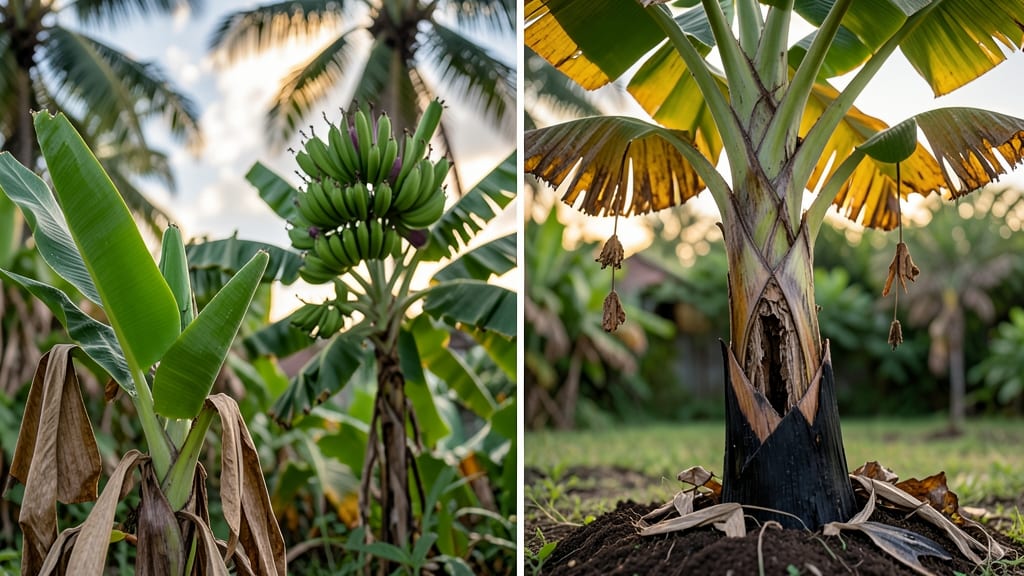
Banana trees die after fruiting because they're monocarpic plants that exhaust their energy producing one harvest before declining. However, they regrow from the base or suckers, allowing continuous harvests with proper care.
This natural lifecycle happens because banana plants direct all their energy into producing fruit, leaving nothing for root or stem maintenance. 🌱 The pseudostem (what looks like a trunk) stores nutrients, but once depleted, the plant collapses.
What's fascinating is how banana growers work with this cycle—removing the old stem and nurturing the new shoots ensures you'll have fresh plants ready for next season's harvest.
For home gardeners, this means you're not losing your banana tree permanently—just its current growth stage. The key is monitoring those suckers (the smaller shoots at the base) and giving them the right conditions to thrive. With smart pruning and care, you can keep the fruiting cycle going for years.
💡 In This Article
- Why Banana Trees Die After Producing Fruit
- How to Extend Banana Tree Lifespan and Harvest Cycles
Why banana trees die after producing fruit
Banana plants are classified as monocarpic, meaning they allocate nearly all their energy to producing a single massive fruit cluster—often weighing 50-100 pounds—before dying. This is unlike perennial trees that fruit repeatedly.
The plant's pseudostem (the fibrous trunk) acts as a nutrient reservoir, storing starches and sugars built up over months of growth. When fruiting begins, these reserves are rapidly depleted to support the energy demands of flower development and fruit maturation.
The process starts with the mother plant's resources being redirected from leaf production to the developing bunch.
You'll notice the leaves yellowing and wilting as nutrients migrate downward—this is the plant's way of "starving" itself to feed the fruit. 🌿 By the time the bananas are ripe, the pseudostem has essentially become a hollow shell, its structural integrity compromised by the nutrient extraction.
The plant's roots also weaken as they're no longer receiving adequate support from the depleted stem.
What makes this fascinating is the evolutionary strategy at play. In the wild, banana plants grow in tropical regions where conditions are ideal for rapid growth and reproduction.
The "die after fruiting" approach ensures that all available energy goes toward producing as many seeds (bananas) as possible in one cycle, maximizing the plant's reproductive success before it collapses.
This is why commercial banana plantations rely on a continuous cycle of new plants rather than trying to preserve the original mother plant.
There's an important distinction between the pseudostem and the actual stem. The pseudostem is made up of tightly packed leaf sheaths that protect the true stem (meristem) at the base. This meristem contains the plant's growth cells and is what gives rise to new shoots after the mother plant dies.
The pseudostem's fibrous structure might look sturdy, but it's actually quite fragile once depleted—it's designed to collapse after fruiting to release nutrients back into the soil for the next generation of plants.
Commercial banana varieties like Cavendish are particularly aggressive in this energy depletion.
They can produce fruit bunches weighing up to 90 pounds with 150-200 individual bananas, which requires an enormous metabolic investment. 🍌 This explains why you'll see banana fields with rows of new plants emerging while the old stems are being removed—it's not a sign of poor management, but rather a natural part of the plant's lifecycle that farmers have learned to work with over centuries.
The death of the mother plant isn't immediate—it can take 3-6 months from when fruiting begins until the plant fully collapses. During this time, the plant's energy is completely focused on the fruit development, with minimal resources going toward maintenance.
This gradual decline allows the suckers (new shoots) to establish themselves before the mother plant's final collapse, ensuring continuity of the crop.